
A reading list anchored on Christopher Alexander's Notes on the Synthesis of Form.
“First, the taking in of scattered particulars under one Idea, so that everyone understands what is being talked about… Second, the separation of the Idea into parts, by dividing it at the joints, as nature directs, not breaking any limb in half as a bad carver might.”
Plato, Phaedrus, 265D
A few weeks ago, Karri Saarinen of Linear published a short essay called “Output isn’t design.” The argument: the form is the easy part. The hard part is understanding the problem deeply enough to know what should exist at all. AI tools, he writes, are good at producing plausible-looking outputs and rarely good at helping you understand the underlying problem. Saarinen puts the diagnosis cleanly: “The form is there. The fit is not.”
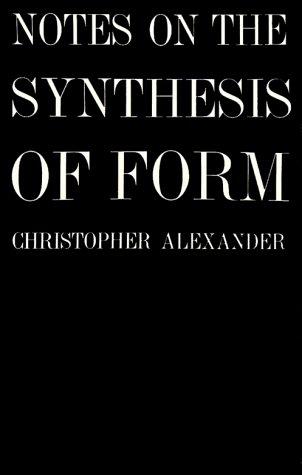
I read it the same week I picked up the book Saarinen points at: Christopher Alexander’s Notes on the Synthesis of Form, published in 1964 as Alexander’s Harvard doctoral dissertation. Alexander used the Plato passage above as his epigraph. Sixty-two years apart, I think both of them are saying the same thing.
Alexander’s argument is that design is the search for a good fit between form and context. Context, in his sense, is the entire web of forces that makes a problem what it is: who the users are, what they need, what the technology can and cannot do, what habits they bring with them, what surprises live in the edge cases, and how all of those forces pull on each other. Bad design appears where those forces are left unresolved. Good design appears where the misfits have been worked through, one at a time. The work, Alexander says, is the work of resolving misfit. The form is the residue.
The book is sixty years old. It still describes the work better than most contemporary frameworks I’ve read.
I’ve been thinking about this in the context of decisions I made this week. A security feature mid-rollout where the wrong framing produces churn. A verification tool that’s technically correct and operationally invisible. A pivot on which AI tools serve our designers without taking the steering wheel out of their hands. Every one of these is a problem of fit before it’s a problem of form. Alexander would have said so in 1964. Saarinen said so last month. The job for design leaders right now is to keep saying so, even as the tools get louder about the form.
If you haven’t read the book, the prose is dense. Alexander wrote it as a doctoral thesis and the formal-method chapters in Part Two are heavy going. Read the introduction and the first three chapters carefully, then skim the rest. The argument lands by chapter three.
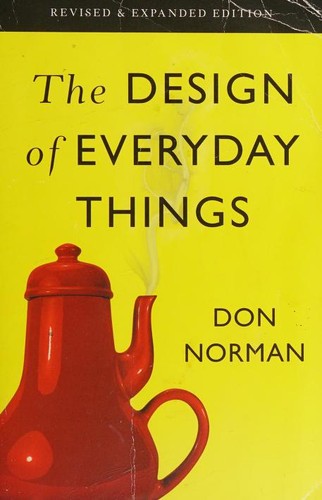
The shelf below collects five other books that built and extended this canon over the half-century since. If Alexander defined the problem of fit, Simon defined the discipline. Schön named the practice of reflection. Norman carried the lineage into the world of products. Chimero brought it forward into the contemporary craft conversation. A Pattern Language, Alexander’s own follow-up, traded the formal method of Notes for a vocabulary of design moves you can name and reuse. The move from sentence to dictionary, and a book that shaped software practice as much as architecture.
Read Alexander first. The rest of the shelf is a long argument that he was right.
The shelf